
The man who was condemned for asking
Socrates and freedom of speech They represent one of the most important moments in the history of philosophy, when truth was punished for asking questions of society. The case still stands today as a lasting warning of what happens when society does not tolerate critical thinking.
In a time when freedom of speech is often either abused or stifled, Socrates' fate helps us understand how thin the line is between order and repression.

Who was Socrates?
Socrates (469–399 BC) was an Athenian philosopher, teacher and thinker, but never a writer. Everything we know about him comes from his students, especially Plato and Xenophon.
Unlike the sophists of his day, Socrates did not teach for money or claim to possess ultimate truth. His famous statement:
„"I know I know nothing"“
it was not a sign of weakness, but the beginning of true knowledge.
The Socratic Method: The Question as a Threat
Socrates used what we call today Socratic method - asking questions so that the interlocutor sees the contradictions in his own views.
He wasn't insulting.
He didn't shout.
He didn't swear.
But it is exposed the ignorance of the powerful, and that was exactly his "sin".
In a society that relies on authority, questions become dangerous.
Accusations: How the truth is silenced
Socrates was accused of:
- spoilage of youth
- disrespecting state gods
Behind those accusations was something else:
he is disturbed the order.
Rather than society confronting the questions he was asking, it was easier to remove the person asking them.
Trial and verdict: Law without measure
At his trial, Socrates did not plead for mercy. He didn't take back his words. He did not renounce the method.
He could have received a lighter sentence if he had shown submission, but he refused.
In the end, he was sentenced to death – by drinking hemlock.
That was the moment when the law formally won, but justice lost.
Socrates' trial and philosophical role are also explained in detail in modern sources such as the Encyclopaedia Britannica, which provides the historical and ethical context of his case. https://www.britannica.com/biography/Socrates
Why didn't Socrates run away?
One of the most profound moments of philosophy is Socrates' decision to don't escape from prison, even though he had the chance.
Why?
Because he believed that:
- the law must exist
- but yes the injustice of the law does not erase the truth
He accepted the punishment, but did not admit guilt.
With this, he showed that the system can punish the body, but it cannot defeat the truth.
Socrates and Freedom of Speech: When the Truth Became a Threat
Socrates teaches us an important lesson:
freedom of speech is not only the right to speak, but also society's willingness to listen.
When the company:
- doesn't tolerate questions
- can't stand criticism
- punishes speech
it does not protect order, it protects its own fear.
Connection with Aristotle: Truth and measure
If Socrates is a symbol truth and conscience, Aristotle is a symbol moderation and reason.
Together they form the foundation of a healthy society:
- Socrates teaches us that one must speak
- Aristotle teaches us how to speak and how to punish
Without Socrates, society sinks into a lie.
Without Aristotle, society sinks into extremes.
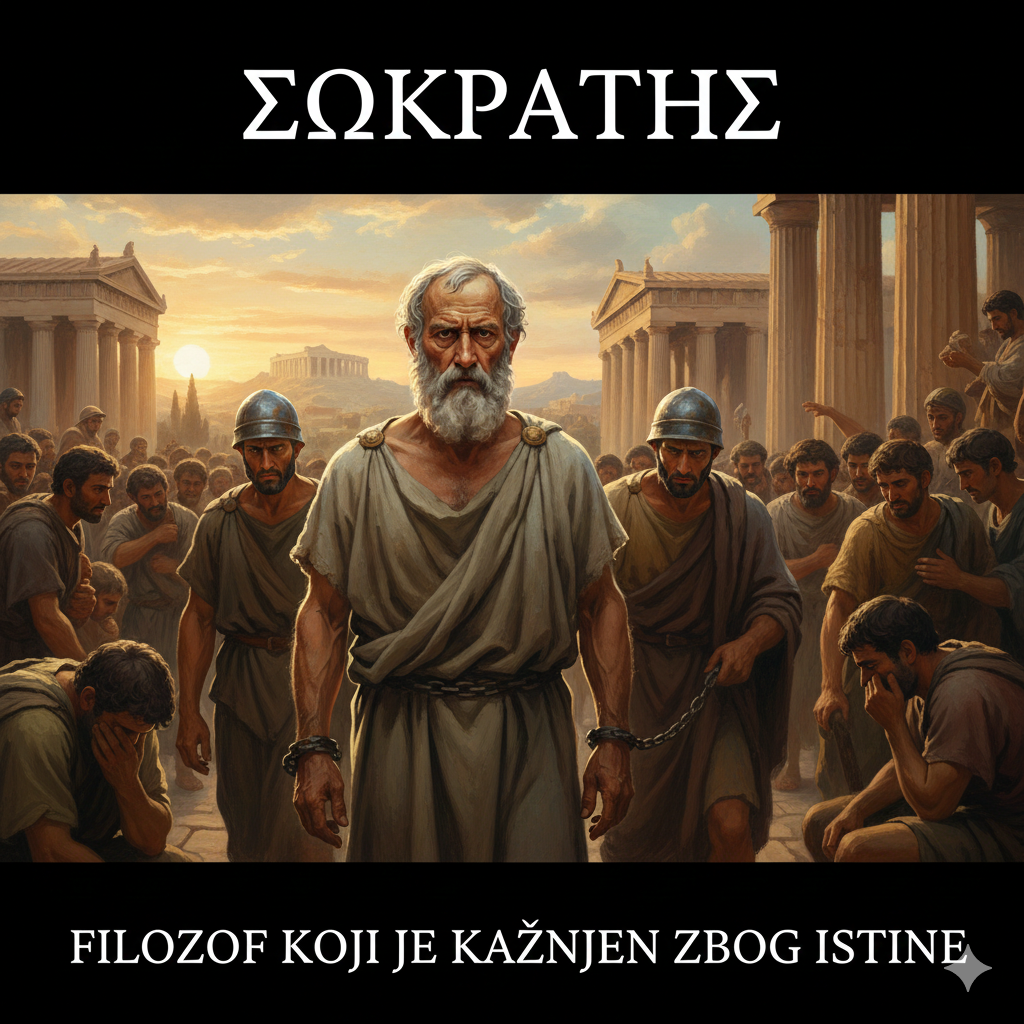
„"The truth does not stop being the truth because it is punished."“
„"Those who tell the truth suffer first - but without them, society has no conscience."“
„"When society punishes questions, it doesn't defend order—it defends fear."“
https://apachannel.com/aristotel-i-mjera-pravda/
Socrates Today: Why Is He Still Important?
In modern society we often see:
- people who are punished for words
- institutions that do not tolerate criticism
- a system that reacts with force instead of dialogue
In this context, Socrates is not a historical figure – he is mirror of society.
Bottom line: A society that punishes questions
Socrates' death was not a defeat of philosophy, but a defeat of a society that lacked the strength to face itself.
A society that punishes questions:
- does not protect order
- does not build justice
- not progressing
The truth may be uncomfortable, but silence is always more expensive.
Socrates still reminds us today:
those who ask are the first to suffer - but without them society has no future.
3 WHAT QUESTIONS?
1️⃣ Does society have the right to punish speech that is unpleasant but non-violent?
2️⃣ Was Socrates condemned for breaking the law or for exposing the ignorance of the powerful?
3️⃣ Would today's society respond better to the questions – or would it repeat the same mistake as Athens?