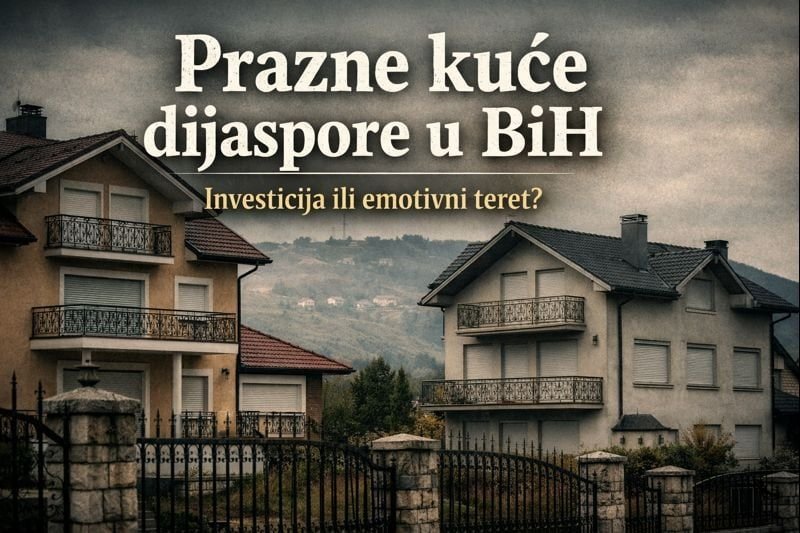
The empty houses of the diaspora in Bosnia and Herzegovina and our former country have become a symbol of sweat, renunciation and a silent sadness that is rarely spoken about. Every time you travel through Bosnia and Herzegovina or our former country, the scene is almost the same: beautiful, modern houses on two or three floors, decorated facades, wrought iron fences – but the shutters are down.
These are houses that "speak" German, Swiss or Austrian. They were built from overtime, weekend work and years of sacrifice.
Behind those facades, however, it often hides silent sadness which is rarely talked about.
Meeting with a foreigner and the truth about the empty houses of the diaspora
Recently, quite by chance, I met a man from Kosovo. We saw each other then and will probably never meet again. It is precisely in such moments - when the interlocutor does not need to pretend to be a successful host - that people are most sincere.
His story was not one of pride, but of deep, silent sorrow.
While we were standing on the way, he started talking about the house he was building "down there". He told me:
“"My friend, I put every atom of strength, every overtime hour and every sweat into those walls. I worked weekends that I should have spent with the kids, just to put up another floor, put up the best facade and the most expensive fence."”
He paused, looked into the distance and added what hurt him the most:
“"And now I realize that those down there will never return. Neither will I, nor my children. Those walls stand empty, and I could have saved that money, invested it in their education or in my own peace. Instead of a home, I built a monument to my fatigue."”
APA analysis: why a stranger's confession is the most important lesson
Within apa analysis (Analytical Approach to Authenticity), we can see this meeting as a mirror of the collective trauma of the Balkan worker in the diaspora.
The phenomenon of “anonymous truth”
Many people hide their regrets from family and friends in order not to appear "failed". In front of an unknown man, without fear of condemnation, the truth comes to the surface.
Mathematics of futility
In order to build a house of 300 square meters in BiH or Kosovo, a worker in Munich has to work thousands of "extra" hours. It's not just hours - it's missed birthdays, coffee with the wife and vacations the body never got.
Generational failure
We build houses to suit our parents and neighborhoods, not our children. Children raised in the EU do not see these houses as a "nest", but as a museum they visit ten days a year.
The cost of overtime and lost time
Sweat and overtime are at the heart of the problem.
Health Guild:
Those hours are paid for with back pain, stress and exhaustion. It often happens that, when the house is finished, the owner no longer has the health to enjoy it.
Missed time with kids:
While it was being built floor by floor, the children were growing up in Germany. Today, there are strangers in that house - they perceive it as an obligation, not as a home.
For those who have already exhausted themselves physically on the construction site, we recommend that they pay attention to liver and blood health in a natural way: Forever Living - support for body and spirit.
The Problem with Masters: The Second Circle of Hell
In addition to the emotional burden, there is also the practical one – craftsmen. Ceramicists, painters and bricklayers often become the biggest nightmare of the diaspora. I personally had a situation where I gave the floor master money in December, he promised to finish in February, and in March he called me to say that he didn't have the money, and the work hadn't even started. In the end, I had to come myself, buy the materials and it was only finished in August. That stress and "chasing" the master while you are thousands of kilometers away, further destroys your health.
Why won't the children come back?
The reality of 2026 is clear:
- Cultural gap: Sarajevo or Pristina are vacation destinations for them, not places to live.
- Economic reasoning: Young people prefer to choose a small apartment in Munich rather than a large house in their parents' village - because time and stability are more valuable than square footage.
Empty houses of the diaspora - financial failure or emotional savings?
If we look at the house as an investment, it is in many cases - dead capital.
- Liquidity: It is difficult to sell it at a realistic price.
- Maintenance: Even an empty house requires constant investment.
- Alternative: If that money had been invested in more mobile capital, today it would have brought security, not worry.
How to avoid this trap? (ApA roadmap for new generations)
If you have just arrived in the diaspora, before the first pallet of bricks, ask yourself:
Where will I really live in 20 years?
First, ensure:
- health
- stability
- time for yourself and family
Only then think about investing "down".
For all of you who are planning a new start, be sure to read our guide: https://apachannel.com/priprema-za-odlazak-u-dijasporu-apa-vodic-za-uspjesan-pocetak/
Freedom of speech on a taboo subject
In our society it is still difficult to say:
“I was wrong to build.”
But it is precisely this truth that saves younger generations from repeating the same mistake. Honesty is healing - both for the one who speaks and for the one who listens.
Conclusion: home is where the people are
In the end, the house is not made of stone but of people.
If people are in Munich, and the house is in Sarajevo or Kosovo – it ceases to be a home and becomes a monument to a phase of life.
Work in the diaspora should serve to create freedom, not new shackles in the form of empty squares.
ApA- Questions
Do you have a similar story?
Do you think today that the construction was the right decision – or a burden you carry in silence?
Share your experience. It can change someone's life.