APA Analysis: Professional experience, not a sales catalog
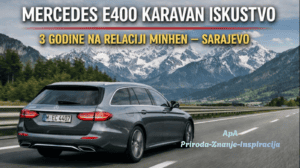
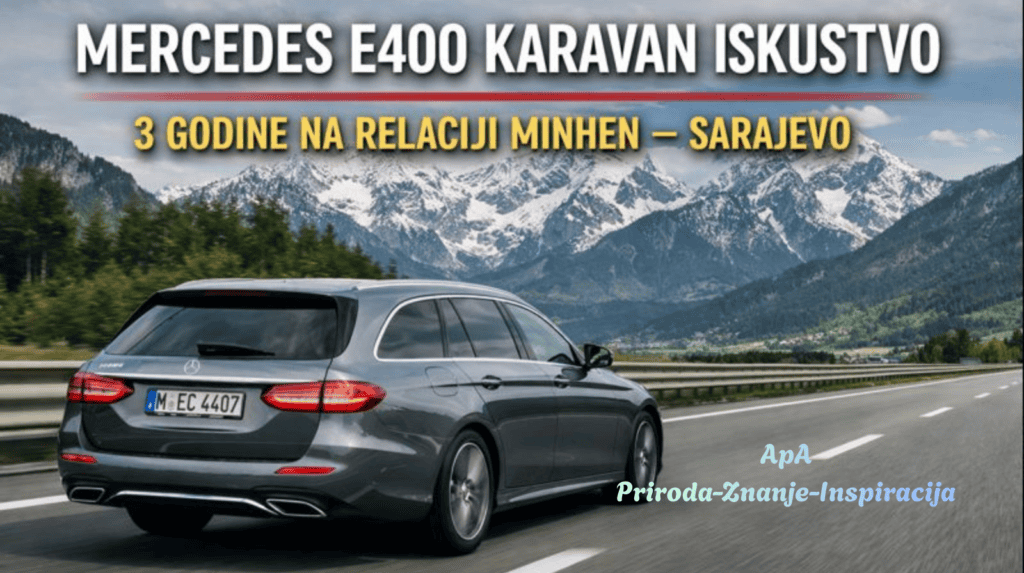
Mercedes E400 Estate (2017) is a car that I've been driving for three full years without a single regret. As someone who graduated in auto mechanics in Sarajevo and Chicago, when I was choosing a car for myself, I wasn't in a hurry. I spent a whole year at the market, exploring every detail: what to buy, how to maintain and why that particular model. Before the keys to this Mercedes ended up in my hands, I went through a process of elimination that few would have the patience to endure.
Today, from a distance of thousands of kilometers on the route Munich – Sarajevo, I can safely say: I didn't screw up - I took a good car.

Mercedes E400 wagon experience: Why a wagon and not a sedan
Down here, in the Balkans, a status symbol is a clear thing: limousine. The wagon is often looked down upon, but as someone who understands chassis construction and aerodynamics, I knew the benefits. Mine is this one Mercedes E400 Estate – more beautiful. Its line is more fluid, and the rear end gives it a touch of robustness.
Apart from aesthetics, mine was also the judge dog 🐕. The trunk in this E-Class is huge and flat, and the factory safety net which goes up makes sure the dog can't go forward while I'm driving around corners. Space, safety and peace of mind - this is what this car offers to every owner who likes to travel with a pet.
Engine – There is no doubt: 6 cylinders are the soul of the car
When it comes to motorization, as a dual-degree mechanic (Sarajevo '95 and Chicago '01), I was uncompromising. My configuration is:
- ✅ 6 cylinders, petrol (V6)
- ❌ 4 cylinders – too weak an engine for this size of body.
- ❌ Diesel – I won't even mention it, I don't drive a tractor! 😄
I tried the 4 cylinder variant before buying. The car runs, but suffers; the engine "screams" with every serious acceleration. I avoided diesel for a reason. Although I drove this Mercedes before Subaru XV diesel full five years (my first diesel after American petrols), I went back to petrol because of technical logic.
Why am I running away from diesel? (Professional Advice)
As a mechanic, I know what they do DPF filters, bad fuel and heavy particles. Modern diesels have become too complicated to maintain in the long run. A petrol engine is cleaner, quieter and longer lasting. My E400 with 333 hp is a machine that doesn't roar, doesn't push itself, but when needed → she simply disappears.
My excursion into the world of diesel: A lesson from the Subaru XV
Before this Mercedes, I drove for five years Subaru XV diesel. That was my first diesel in my life. Why only then? Because in America, during my schooling and work in Chicago, I drove exclusively gasoline cars. There, gasoline is standard, power is taken for granted, and diesel was reserved for trucks.
While I respect Subaru as a brand, those five years with diesel were an eye-opener for me. As a mechanic, it became clear to me why modern diesel technology, despite its lower fuel consumption, brings headaches that a petrol engine simply doesn't.
Why NOT DIESEL? (Expert explanation from a mechanic)
As someone who repaired cars both in Sarajevo and in America, I have a clear opinion about modern diesels. I don't want to drive a tractor, hehehe. Here's why:
- DPF Filters and Particulates: Modern diesels are loaded with aftertreatment systems. DPF (Diesel Particulate Filter) is a cancer for anyone who drives in the city. As soon as the filter fills up, regenerations begin, consumption increases, and if the process is interrupted, you enter “limp mode”.
- Harmful particles: Regardless of all the filters, diesels emit micro-particles that are extremely harmful. In this regard, gasoline is much cleaner and "healthier" for the environment.
- Fuel filters and sensitivity: Our fuel in the Balkans is often not of the same quality as in Germany. The diesel injection system is so sensitive that one bad round of fuel can cause damage of several thousand euros to the nozzles and the high pressure pump.
That's why my choice was 6 cylinders, petrol (V6). That engine works like a gentleman, without vibrations and without fear that a clogged filter will leave me on the way through the Alps.
Life between Munich and Sarajevo has its own specificities, which we wrote about in more detail in ApA guide to preparing for departure to the diaspora. https://apachannel.com/priprema-za-odlazak-u-dijasporu-apa-vodic-za-uspjesan-pocetak/
Subaru Outback as a competitor: Why did Mercedes win?
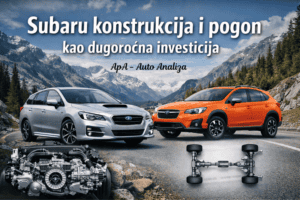
Before buying an E-Class, Subaru Outback was a serious favorite of mine. I am a big fan of Subaru and their legendary symmetrical four-wheel drive (AWD). They are indestructible cars, but two things decided in favor of Mercedes:
- Seller access: Although I was ready to buy, at Subaru they did not want to meet me about the color of the car for the same money. In that price class, you expect at least a minimum of flexibility.
- Hermetic silence: As a mechanic, I appreciate the finish. When you drive over 130 km/h, the Mercedes is “hermetically sealed”. The cabin is whisper quiet, while the Subaru, due to its design and engine, is noticeably noisier on the highway.
Semi-automated driving and smart systems
My 2017 Mercedes has technology that still looks impressive today, in 2025. For someone who lives in Munich and likes to go to Sarajevo, these systems are a lifesaver.
- Self-alignment: All you have to do is turn on the blinker, and the car will scan the surroundings and gently move into the other lane. No stress, no fuss.
- Distronic Plus: On the highway, I put it in cruise mode, and it keeps its distance. It brakes itself when someone slows down in front of me and accelerates itself.
- Multibeam LED lights: This was for me. the most important factor when buying. When I return from Sarajevo and it gets dark through the Alps, these lights turn the night into day. Visibility is the key to safety, especially on mountain passes.
Technical data and history: W213 (2017)
The Mercedes E-Class W213 is a masterpiece of the team that leads Gorden Wagener. His philosophy of "Sensual Purity" reached its peak here - the car looks powerful, but not aggressive.
| Specification | Mercedes E400 4MATIC (W213) |
| Engine | 3.0 L V6 Twin Turbo |
| Strength | 333 hp / 480 Nm of torque |
| Drive | 4MATIC (Four-wheel drive) |
| Gearbox | 9G-TRONIC (Nine speed) |
| Designer | Gorden Wagener |
Strength and security: From runner to family man
I still have that "American" spirit in me - as a kid I loved racing. But today, with mechanical degrees from Sarajevo and Chicago, I see strength as a safety factor.
I taught my wife not to be afraid of the engine's power. Today she enjoys driving because she knows she can overtake anyone without any trouble. As soon as you give it a go, it "goes" - no need for Sport+ mode. For our mountains like Jahorina, Bjelašnica, Trebević and Igman, four-wheel drive and 333 horses mean you'll never get stuck in the snow.
Consumption - Let's be realistic, the bear likes to drink
This is not a car for people who count every penny at the pump. Those looking for savings should look at hybrids or small city cars. My real life experience with the E400 is as follows:
Mountain climbs (Jahorina, Alps, Bjelašnica, Trebević, Igman): There's no focus on spending, there's enjoyment, but be prepared for double-digit numbers.
Sarajevo: 12–13 liters (this is the minimum, in winter it can be more).
Munich (city driving) About 10 liters, depending on the weight of the foot on the gas.
Open plain: Woman in me 6.8-7.3 Jazz 8.5-9.2
But, there is a catch. When Dajdža sits behind the wheel and "steps" on it a little, that tame match turns into a real one grizzly bear 🐻. The sound of the V6 engine changes, the car stiffens and shows its other face.
Servicing: What does the profession say?
Great service on 120,000 km is mandatory and expensive. I had mine done in Sarajevo and it cost approx 2 and a bit thousands. In an authorized service center in Munich, it would be significantly more expensive. As a mechanic, I advise: don't skimp on parts. This car requires premium oil and original filters to give you years of service.
I plan to drive it. 5 years, just like they do in America, and then I exchange it for a new model. It's a cycle that ensures you're always driving a reliable and technologically advanced car.
What I DON'T Like (European vs. American Version)
Although I love this car, I have to be honest and list a few things that annoy me, and they concern Mercedes' policy for the European market. In America, the E-Class wagon (W213) comes "loaded" with things that we in Europe have to pay a lot extra for or don't have at all:
- Third headquarters: In the US version, the wagon often comes with those rear-facing auxiliary seats in the trunk.
- Seat adjustment: In America you get fully electric seats with memory. Here in the “standard” package you often get only an electric backrest, while you move forward and backward using hand cranks. Shameful for that class.
- Air-Balance system: In US models, "perfume in the glove compartment" is almost standard, while in Europe it is rarely seen without special surcharges.
These are small things, but when you know that someone "across the pond" gets more for the same or less money, it leaves a bitter taste in your mouth.
Technical specifications for the Mercedes E400 (W213) are also available through the manufacturer's official data. https://en.wikipedia.org/wiki/Mercedes-Benz_E-Class_(W213)
APA Conclusion
After three years and thousands of kilometers, I can say that the Mercedes E400 Estate is the best choice I could have made. It offers safety, incredible power, and luxury that doesn't tire you out.
Questions for readers
- Would you rather drive a 6-cylinder petrol car or an economical diesel?
- How important is sound insulation to you at speeds over 130 km/h?
- Do you think wagons are really more practical than sedans?
Write to me in the comments! As a double degree mechanic, I'm here to answer your technical questions.