Diaspora Mental Health: Why is the Invisible Burden Still a Taboo?
Why is diaspora mental health such a challenge?
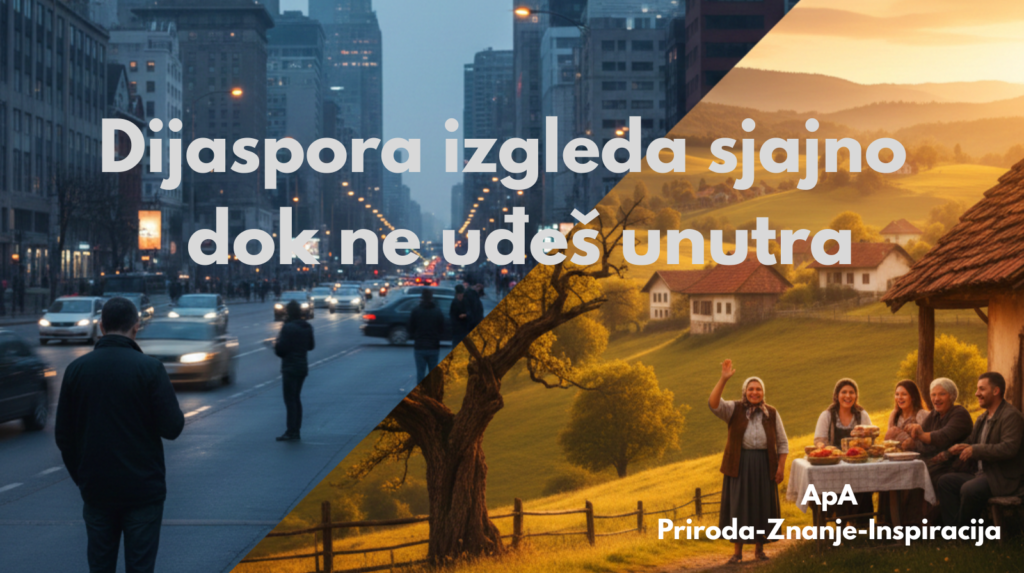
Diaspora mental health is a topic that is almost never discussed openly. In the Balkans, filtered images of diaspora success always stand out: new houses, cars, secure work permits, "German papers", stability and order. People only see the facade.
But what you don't see is the internal war that almost every man who leaves "belly for bread" is fighting. Diaspora is a psychological journey through chronic stress, deep nostalgia, constant pressures, loneliness, emotional burnout and an attempt to find an identity between two countries.
“Forever Holiday Sale – Aloe Vera Products at 15% Discount. ApA-Channel.”
The ApA signpost says: “"Strength is not in silence, but in honesty. Diaspora can be difficult, but it is also a path of growth, courage and new beginnings."”
Moral Pressure: How can you say "I'm sorry" if you've gone to a country that is generally considered "Paradise"?
The taboo exists because admitting that it is difficult for you means admitting it defeat or weakness, and we Balkans hate to be seen as unsuccessful. Going abroad becomes a sacred mission that must not fail.
🔥 1. Mental Health Stress in the diaspora - an invisible burden that slowly eats you
Diaspora stress is not a short-term concern, but systematic load which slowly consumes you from the inside, often to the point of physical illness.
🔹 "I have to succeed" - pressure that has no break (Psychology of Expectations)
When you go out, it's no longer a matter of personal choice, but collective obligations. You have to succeed — for yourself, for your parents, children, family, village, city, and for everyone who follows you. And worst of all: you have to justify why you left.
Every problem, every mistake, every unplanned expense, everything feels like you are ruining the „American”, „German” or „Dutch“ dream. That is why this pressure manifests itself as constant performance anxiety.
🔹 Work like a machine - no room for emotions (Stories from the Field)
I've been to three diaspora countries, and although the cultures are different, work rhythm of expatriates is similar to: inhumane.
🇺🇸 Chicago – City of my Youth: America beats you with pace - everything is possible, but everything costs twice as much: time, health, nerves. Everyone is working, running, smiling – but hardly anyone really alive.
🇳🇱 Netherlands - Coldness in Contact: Everything is arranged - except for the heat. Emotional distance is dominant. You don't know who your neighbor is for three years, which leads to deep loneliness.
🇩🇪 Munich – Stresa Center: The best system, but also the coolest rhythm of life. Live for plans, bills, deadlines.
And in all three countries – one thing is common:
you work like a machine - your body is a tool for making money
there is no one to ask how you are - there is a lack of genuine care
you have no time for yourself - you have nowhere to "take out" your emotions
you have no one to tell that you are in pain - lack of a trusted network
🔹 Fear of losing your job - kills silently
Fear is not a small thing. It is in the diaspora existential panic because you know that your existence hangs in the balance:
the apartment is expensive (often 35-60% income)
Overhead costs eat up half of the salary.
taxes and insurance are unforgiving (the system is brutal)
the employer can replace you in 24 hours
That's why people they remain silent, endure mobbing, absorb stress and they don't ask for help. This burden of accumulated stress begins to deteriorate mental health.
Diaspora mental health It becomes especially vulnerable when symptoms of stress and emotional strain are ignored for a long time.
⚡ 2. Burnout – when the body says STOP and you continue (Clinical Review)
Burnout is not just tiredness – it is empty tank energy, motivation and emotional capacity.
🛑 Symptoms of the Expatriate:
fatigue that persists even after sleep (chronic fatigue)
"foggy" head (cognitive impairment)
emotional numbness (cynicism, indifference)
loss of motivation for things you used to love
outbursts of nervousness because of trifles (short fuse)
insomnia or sleep disorders
unrealistic expectations of oneself (perfectionism)
In the diaspora burnout it occurs faster and is harder to admit because you are constantly under pressure to:
you work more but at home, to make it "worth it"„
show that you are worth and that you are better than the others
you don't leave a bad "impression of a foreigner"„
you don't disappoint the family (financially)
you hide your weaknesses under the guise of a strong person
Once you burn out - it takes a long, long time to get back to "normal", and you often need professional help.
💔 3. Nostalgia – a wound that is not physical, but hurts the deepest (Loss of Belonging)
Nostalgia is not just sadness. That's it sadness + loneliness + emptiness + loss of identity. It is the pain of emigration from context.
Missing people: Parents, friends, godparents – a support network.
Missing language: Your mother tongue is not just about communication; it's the way you dream, think and feel.
Ordinaryness is missing: Unannounced coffee with a neighbor, the smell of home cooking, spontaneous jokes, bag.
What is missing the most is that you belong. Because in the diaspora you are often just a "foreigner", guest worker or "the new one".
And when you return home — you feel that you have changed there too. Your worries are not theirs, your stories are not close to them. This is what hurts the most: you are nowhere 100% native. That feeling non-affiliation is the essence of the expatriate's mental struggle.
“"Loneliness, nostalgia and emotional breakdowns of the diaspora are most intensified during the winter months, so you may also benefit from our text Mental health in winter, where we give practical advice on how to deal with seasonal psychological challenges.” https://apachannel.com/mentalno-zdravlje-zimi-kako-se-nositi-sa-sezonskim-izazovima/
😂 4. An anecdote from the diaspora – more real than all statistics (Ventil za Emocije)
So that everything is not black, we have to enter i dark humor, our Balkan valve that saves the brain from explosion.
I was walking with my dog one day. They were building a kindergarten next to me, a construction site full of our people taking a break – some working, some shitting as usual.
And one character (let's call him Selim, because he sounds like Selim) coek is Selim's mother I assume to myself hehehehe screams at the top of his voice in front of everyone, swearing to himself:
“"Who forced you to come here?! Well, you knew what was waiting for you! You want money — and then fuck! Sleep with seven other people in the room, push the guards, endure, get used to it! That's what you need when you wanted 'Heaven-Paradise'!"‘
People laugh, but I laugh the most. Because Selim didn't talk nonsense - he talked our harsh reality. There really are some in the rooms. 5, 6, 7 like sardines. A man comes for a better tomorrow - and ends up in a bunk bed, above a man snoring like a chainsaw.
Such moments are painful and funny at the same time. You laugh until you burst.. That is the diaspora. Black humor saves what the system breaks.
One hour in the forest, in the park, or by the water, heals more than one day on the phone.
Scientifically proven: Being in nature drastically lowers the stress level (cortisol) and returns focus. Use it.
The World Health Organization (WHO) states that the mental health of migrants is at risk due to stress, isolation, and pressures of integration. https://www.who.int
🌙 6. Important message to people over 50 (Reality and Caution)
People of 50+ SHOULD NOT go to the diaspora to "start over".
Why?
It is physically too difficult: The jobs are mostly difficult, and the body is less able to withstand the effort.
Bureaucracy is brutal: The language, the documents, the adjustment to new rules – it's too much of a shock for the elderly.
Loneliness kills faster than work: Losing a social network at that age is a huge risk.
Competition is strong: There is a good chance that you are seen as "cheap labor".
It is better to organize a quiet life at home. but to start a fight in a country where the system and pace will crush you.
Appeal: If any of you older people are reading this: don't risk your health for a few extra euros. Peace, health, and closeness to your family are worth more than anything.
The highest quality Aloe Vera preserves its structure, purity and nutritional value thanks to a controlled processing process. This is not marketing – it is methodology.
Sarajevo as a City of Old Men: An Analysis of Silence, Economic Greed, and Generational Departing A Vacation That Brings Sadness Every time I leave Munich for Sarajevo, my heart aches.
The empty houses of the diaspora in Bosnia and Herzegovina and our former state have become a symbol of sweat, renunciation, and a silent sadness that is rarely spoken about.