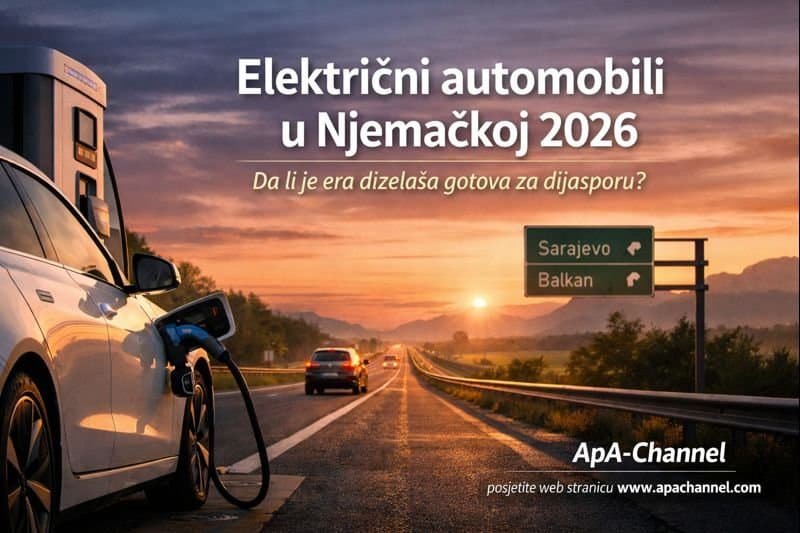
Electric cars in Germany in 2026 are becoming an increasingly important topic for the diaspora living between two systems – German rules and Balkan habits. As diesels lose their privileges, more and more of our people are wondering if it is time to switch to electric power.
For decades, for our people in Frankfurt, Munich or Stuttgart, there was a simple formula: a German car, a powerful diesel engine and low consumption on the highway to the homeland. However, the entry into 2026 brings quiet but profound changes to German roads. As regulations gradually tighten, a key question arises for the diaspora: does diesel still make sense - or has the electric car become a realistic alternative?
In this apa analysis In this article, we explore the economic, practical, and psychological factors that influence our diaspora's decision to buy a car in Germany in 2026.

1. Context 2026: German politics and the future of the combustion engine
German environmental policy has been showing a clear direction for years. Increasing CO₂ taxes and the expansion of low- and zero-emission zones are making diesel increasingly expensive and limited, especially in urban areas.
- CO₂ levies: the price of diesel is rising not only in the market, but also in fiscal terms
- City zones: more and more cities are restricting access to vehicles with emissions
- The value of the second-hand car: diesels lose their price faster because customers think long term
👉 For the diaspora that often travels between Germany and the Balkans, this is no longer a theory, but practical calculation.
2. Economic calculation: Electric car vs. diesel (2026)
| Parameter | Diesel (Euro 6) | Electric car |
|---|---|---|
| Fuel / electricity | High price (CO₂ taxes) | Cheap at home, more expensive on the highway |
| Annual tax | €250–€500 | 0 € |
| Maintenance | Oil, DPF, turbine | Minimum |
| Reach | 800–1000 km | 350–550 km |
Key ApA insight:
Although electricity in Germany is more expensive than before, total EV costs are still up to 30–40% lower, especially in the long term.
ApA note:
Repairing the DPF or turbine on a 5-6 year old diesel often "eats" all the savings made on consumption.
3. The way to the homeland: the greatest fear of the diaspora
The electric car does not scare the diaspora because of ecology, but because way home.
- Germany and Austria: dense network of fast chargers
- Balkans: infrastructure is developing but requires planning
- Charging time: today 15–25 minutes on ultra-fast chargers
The reality is that most drivers definitely take breaks every 3-4 hours. The difference is more psychological rather than real.
4. Diaspora "down under": what do people really drive in the summer?
This summer, while standing in a parking lot in Sarajevo, I noticed an interesting detail:
German plates are still dominant – but not all diesels anymore.
You are increasingly seeing:
- EV as the first car in Germany
- older diesel left "down"“
- or a plug-in hybrid as a compromise
The diaspora is already alive two car worlds, only he still rarely admits it out loud.
5. The Psychology of Ownership: From Status to Functionality
Diesel used to be a symbol of success. Today, the perception is changing.
Silence, digitization and lower costs are becoming a new status signal.
“The "chief in the village" is no longer the one with the loudest engine, but the one who knows how to count.
6. Subsidies and incentives in Germany 2026.
- Official vehicles (Gewerbe): 0.25% tax for EV
- Spreadsheets: privileged parking in many cities
- THG-Quote: annual payment due to CO₂ reduction
7. What about used diesel cars?
The low price of diesel in Germany looks tempting, but it carries risks:
where will you be driving that car in 3–5 years?
If the Balkans follow the same regulatory path, "buying cheap" could become a costly mistake.
APA ANALYSIS: How to make the right decision?
Ask yourself three questions:
- How much do I drive per day?
- Do I have a charger at home or at work?
- How often do I really go to the Balkans?
If the answer is: every day short distances + rare long journeys, an electric car makes sense.
ApA note: Planning for the future in Germany means using resources responsibly – from smart car chargers to Forever Living supplements that support your vitality. https://thealoeveraco.shop/ZKYQUtGm
Conclusion: Is the diesel era over?
Not overnight. But the year 2026 clearly shows that it is diesel in the descending phase, especially for new purchases in Germany.
The diaspora is the first to feel the changes - because it lives between two systems.
While diesel is still a dream in the Balkans, the German reality is quieter, electric, and more economically rational.
🔔 ApA roadmap – CTA
Have you already switched to electric drive or are you still sticking to the proven diesel?
Share your experiences on the way to your homeland in the comments and read ours as well apa analysis text Station wagon or SUV – what is the smarter choice in 2026? https://apachannel.com/karavan-ili-suv-njemacka/

Kupovna moć nekad i sad – Jesmo li bogatiji? | ApA analiza
Key Takeaways Kupovna moć nekad i sad – Zašto danas imamo više novca, a manje mira Analiza kupovne moći nekad i sad postaje jedno od

VW Golf through generations – Icon of the Balkans | Exclusive ApA analysis
The VW Golf through generations best shows how a car can transcend technology and become part of a region's identity. Key Takeaways The VW Golf through generations as a car

Forever Immune Gummy Vitamins – 10 vitamins and zinc for immunity
Forever Immune Gummy vitamins represent a modern approach to supplementation, combining 10 vitamins and zinc in the convenient form of two gummies per day. 1. Key Takeaways This app

ApA Brain Teaser – Medicinal Herb Challenge
This ApA brain teaser presents five challenges through which you can test your knowledge about medicinal plants and check how connected you are with nature. Solve the tasks below, think first
Subaru Construction and Powertrain - Why is Subaru different? ApA
Subaru design and drivetrain are not just technical details — they are a brand philosophy that defines stability, longevity and safety in real-world driving conditions. Key messages

Two dogs in the house - from "never again" to a pack under the same roof
Having two dogs in the house used to sound like total chaos to me. After 15 years with one dog I was convinced I would never have another