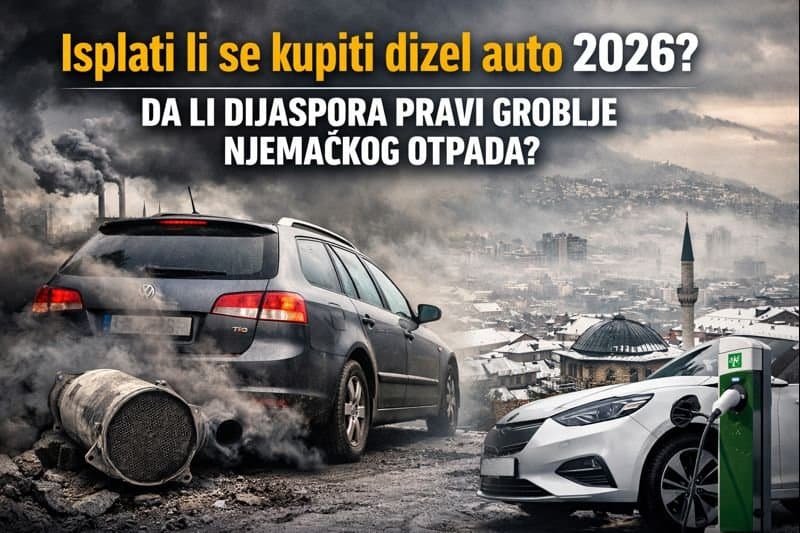
Is the diaspora turning the Balkans into a graveyard of German waste?
Diesel car 2026 and diaspora are becoming a topic that can no longer be discussed only through fuel prices and consumption. Buying a used diesel car in Germany and sending it to the Balkans today raises questions of morality, ecology and the health of the people who live there. For decades, buying a used diesel car in Germany and “sending it down” after a few years was a symbol of the success of the average expatriate. It was proof that you had „made it abroad“, that you had a car that “pulled”, that was reliable and that, at least on paper, was still the European standard. However, in 2026, this practice is no longer just a question of money. It has become a question of morality, ecology and – most importantly – the health of our children and parents who remained in the Balkans.
While Germany is rapidly cleaning up its cities through subsidies for electric vehicles, city center bans, and draconian emissions taxes, the Balkans are facing a harsh reality: we have become the ultimate destination for cars that the European Union no longer wants. What is a “problem” in Munich, Stuttgart, or Frankfurt becomes an “opportunity” here.
1. Diesel car 2026 diaspora: German mathematics and Balkan improvisation
In Germany, the calculation is brutally clear and cold. When a diesel car exceeds the permitted emission limits, the owner faces real costs. Repairing or replacing a DPF filter, EGR valve or catalytic converter costs between 1,500 and 3,000 euros, and often more. For the average driver, it is a decision moment: either an expensive repair or selling the vehicle.
In the Balkans, the solution is more “creative”, faster and – much cheaper.
- Physical removal of the DPF filter: for 100–200 euros, a local craftsman will remove the honeycomb from the filter.
- Software shutdown of the system: the car's electronics are "tricked" into thinking everything is fine.
- Short-term profit: the car runs "better", consumes less and there are no warning lights.
But the long-term result is clear: behind such a vehicle remains a cloud of microparticles that directly enter people's lungs. Particles that our technical examinations still do not adequately measure, but which the lungs feel very much.
“As we explained in detail in our video analysis on the ApA Channel, removing the DPF filter is not only an environmental offense, but a direct attack on the health of your loved ones.”
2. The harsh reality: we would all fail the real eco-test
The fact is simple and unpleasant: almost no diesel older than ten years, with emission control systems disabled or removed, could pass a proper European technical inspection. If German particle measurement standards were introduced in the Balkans tomorrow, estimates suggest that around 70% of the vehicle fleet would be immediately taken off the road.
The paradox is painful. The diaspora, trying to avoid high maintenance costs in Germany, places these same vehicles on the domestic market. This directly contributes to the fact that cities like Sarajevo, Tuzla, Skopje or Belgrade end up on the lists of the most polluted cities in the world every winter.
ApA note: we do not poison "some people over there". We are poisoning our own neighbors, relatives, parents and children who are playing on the side of the roads where our "cured" diesels pass without filters.
According to the data European Environment Agency (EEA), air pollution caused by traffic and diesel vehicles is one of the main factors in increased mortality and chronic diseases in urban areas across Europe.https://www.eea.europa.eu/en
3. Health as collateral damage
Air pollution is no longer an abstract concept. It is increased cases of asthma in children, chronic bronchitis in the elderly, problems with the heart and blood vessels. It is the queues in hospitals and pharmacies. It is a price that is not paid at the pump, but in the waiting rooms.
And while we often justify ourselves with the phrase: "We have no choice," the question is - do we really have no choice, or are we just choosing the easy way out? It is understandable that people look at finances, but should those who did not participate in the decision pay the price?
4. Diesel car 2026 – the responsibility of the diaspora towards the Balkans
Thinking about the car in 2026 cannot be separated from thinking about quality of life. If we are talking about planning for the future in Germany, then we are also talking about the responsible use of resources – from smart chargers for electric vehicles to how we protect our bodies in a world full of toxins.
If we are ready to spend tens of thousands of euros for a car, why do we save on clean air, prevention and quality nutrients? This is a question that every member of the diaspora must ask themselves, regardless of whether they drive a diesel, hybrid or electric car.
Before making the final decision to buy a car, especially if you're thinking about practicality and long-term costs, it's worth reading apa test wagon or sedan, where it is explained in detail to whom which option is really worth it. https://apachannel.com/karavan-ili-limuzina/
5. Is diesel even worth it in 2026? (real calculus)
If we look at the cold numbers for someone who lives in Germany and regularly travels to the Balkans, the picture becomes clearer:
- Annual tax: for diesel it increases year after year due to the CO₂ penalty, while for electric cars it is minimal or non-existent.
- Fuel price: diesel fuel approaches and exceeds 2 euros per liter, while electricity, with a home charger, is significantly cheaper.
- Entering cities: Diesels are increasingly banned from entering city centers, while electric vehicles are unrestricted.
- Vehicle value: diesels lose value rapidly, often over 20% per year.
- Moral cost: high - because pollution has concrete consequences.
6. Psychological profile of the buyer: “Let him smoke, just let him draw”
Why is diesel still being bought? Because diesel in the Balkans is not just a fuel – it is a symbol. A symbol of power, endurance and a “real car”. But that endurance has a price that is not immediately apparent.
In the ApA behavioral analysis, the diaspora today is clearly divided into two groups:
- Environmentally conscious, who embrace hybrids and electric vehicles, charging breaks, and a new rhythm of life.
- Traditionalists, who stick to diesel until the last minute, ignoring the fact that their vehicle rapidly loses value every year.
7. Conclusion: Diesel car 2026 and the diaspora: responsibility towards the Balkans
Buying a car in 2026 is a test of maturity. We can continue to fill the Balkans with waste that Europe no longer wants, or we can be part of the change. The engine we choose doesn't just pump out horsepower – it also pumps out particles that linger in the lungs of those we love most.
The future is clean, quiet and electric. Everything else is just an attempt to escape from the inevitable.