
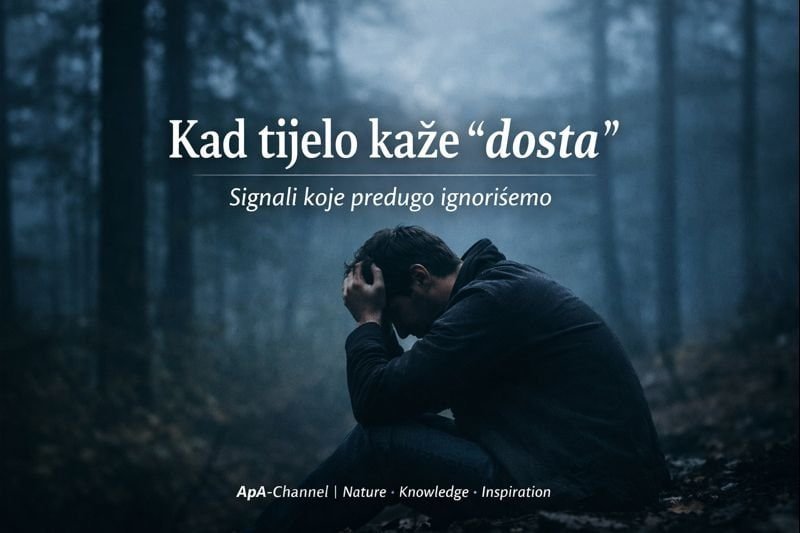
The silence that shouts the loudest
When the body says "enough is enough," it is not weakness but a warning that we have ignored for too long – especially in the fast pace of diaspora and modern life. How many times have you said to yourself: "It's nothing, it'll pass, I'm just a little tired"?
In the world we live in - and especially in the dynamics of the diaspora where standards are high, responsibility is high, and the pace is relentless - we easily forget one basic truth: The body never lies.
A headache that you swallow with a pill. Chest heaviness you attribute to coffee. Insomnia that you justify with worries. These are not coincidences. These are messages. And although this pressure is especially felt in the diaspora, the truth is universal: every body reacts the same when we live too long beyond our limits.
In this APA analysis, we are talking about that critical moment when the body stops whispering - and starts speaking clearly: „"Enough."“
1. APA analysis: The body as a mirror of the repressed soul
In the APA mentoring approach, we view the body not just as a biological system, but as the most sincere ally we have. The mind is a master of rationalization. It says:
- „"Hold on a little longer"“
- „"Others can do more"“
- „"You have no right to stop"“
- „"What will the family, the boss, the environment say?"“
But the body has no filters. It reacts directly and honestly. Suppressed emotions, unspoken fears and constant stress do not go away. They move to the muscles, organs, and nervous system.
APA conclusion: Pain is not your enemy. Pain is an alarm that tries to save you from complete combustion (burnout).
2. Why do we have the hardest time hearing signals in the diaspora?
Life outside the homeland carries a specific burden. In systems where discipline and productivity are valued, you are rarely asked how you are doing. Although this pressure is stripped to the core in the diaspora, it is present wherever the pace of life is faster than the beat of our hearts.
The most common pitfalls:
- Fear of weakness: Being sick or slowing down is often seen as a defeat.
- Feeling of debt: We work across borders because we want a "better life" for the family - often at the cost of our own health.
- Emotional isolation: The lack of deep social support makes us bear the stress alone.
In such circumstances, the body becomes the only voice of reason that tries to restore the balance that the mind lost long ago.
3. When the body says enough: signals you should not ignore
In APA analysis, we do not stop at the symptom - we look for the message behind it. Be honest with yourself:
- Chronic fatigue that does not go away after sleep: If you wake up more tired than you went to bed, your nervous system is in a state of constant alert (fight or flight).
- Tension in the neck and shoulders: You are literally carrying a burden of responsibility that is not yours alone.
- Digestive problems: The stomach is our "second brain". An upset stomach is often a sign of fear or repressed decisions.
- Sudden irritability: When the body has no more capacity, every little thing becomes a trigger.
4. When stress becomes a physical reality
Long-term ignoring of signals leads to more serious conditions. Psychosomatics teaches us that the body "gives in" where we are most sensitive:
- Cardiovascular signals: Heart palpitations at rest.
- Hormonal imbalance: Constantly elevated cortisol weakens immunity.
- Skin reactions: Eczema and rashes as an external sign of internal combustion.
The body does not punish - it warns.
5. APA roadmap: How to get back to yourself?
You don't have to tear your life down to heal. You just need to start listening.
- Recognition: Stop and say to yourself, "I'm tired—and that's okay." Stopping fighting yourself is the beginning of healing.
- Setting boundaries: A "no" to others is often the biggest "yes" to your health.
- Conscious pause: Every day 10 minutes of silence. No phone. No music. Just a breath.
- Back to nature: In the APA philosophy, nature is not a luxury – it is therapy. A walk in the forest restores the body to its natural rhythm.
6. ApA message: You are not your performance
We are taught that we are worth what we produce. The APA analysis shatters that illusion. Your worth is innate. If your body says "I can't" today - listen to it. He doesn't ask you to give up your dreams, he asks you to reach them alive, healthy and present.
APA Reader's Guide – Quick Analysis
| Body signal | What is your body telling you? | APA recommendation |
| Headache | Too much information, too little peace of mind. | Turn off screens for 2 hours. |
| Back pain | You carry too much responsibility. | Delegate one task to another. |
| Insomnia | Your mind is in the future or the past. | Breathing exercise 4-7-8 before sleep. |
| Tightness in the throat | You didn't say something important. | Write your emotions in a journal. |
The World Health Organization (WHO) recognizes burnout as a serious syndrome associated with chronic stress at work. https://www.who.int/
Conclusion: Returning home – to your body
When the body says enough, it's not the end - it's the beginning of a more conscious life. It is an invitation to a new beginning. An invitation to stop being a robot and become a human who feels, breathes and lives again.
Within APA channel, our goal is to teach you to recognize the signals in time. Because the most expensive thing you can pay - whether in the diaspora or in your homeland - is not rent or taxes. It's your broken health.
If you want to understand more deeply how stress affects the body and what physical consequences it leaves when we ignore it for a long time, read our detailed APA guide on how stress affects the body on the ApA-Channel. https://apachannel.com/kako-stres-utice-na-tijelo/
❓ApA Questions for you (Comments are open):
- What signal has your body been sending for a long time and you are ignoring it?
- What would happen if you took just 15 minutes tomorrow exclusively for yourself?
- Are your mind and your body on the same page right now?
APA Call: Share this text with someone you know needs peace today. Follow up APA channel for more everyday pointers towards a healthier life.